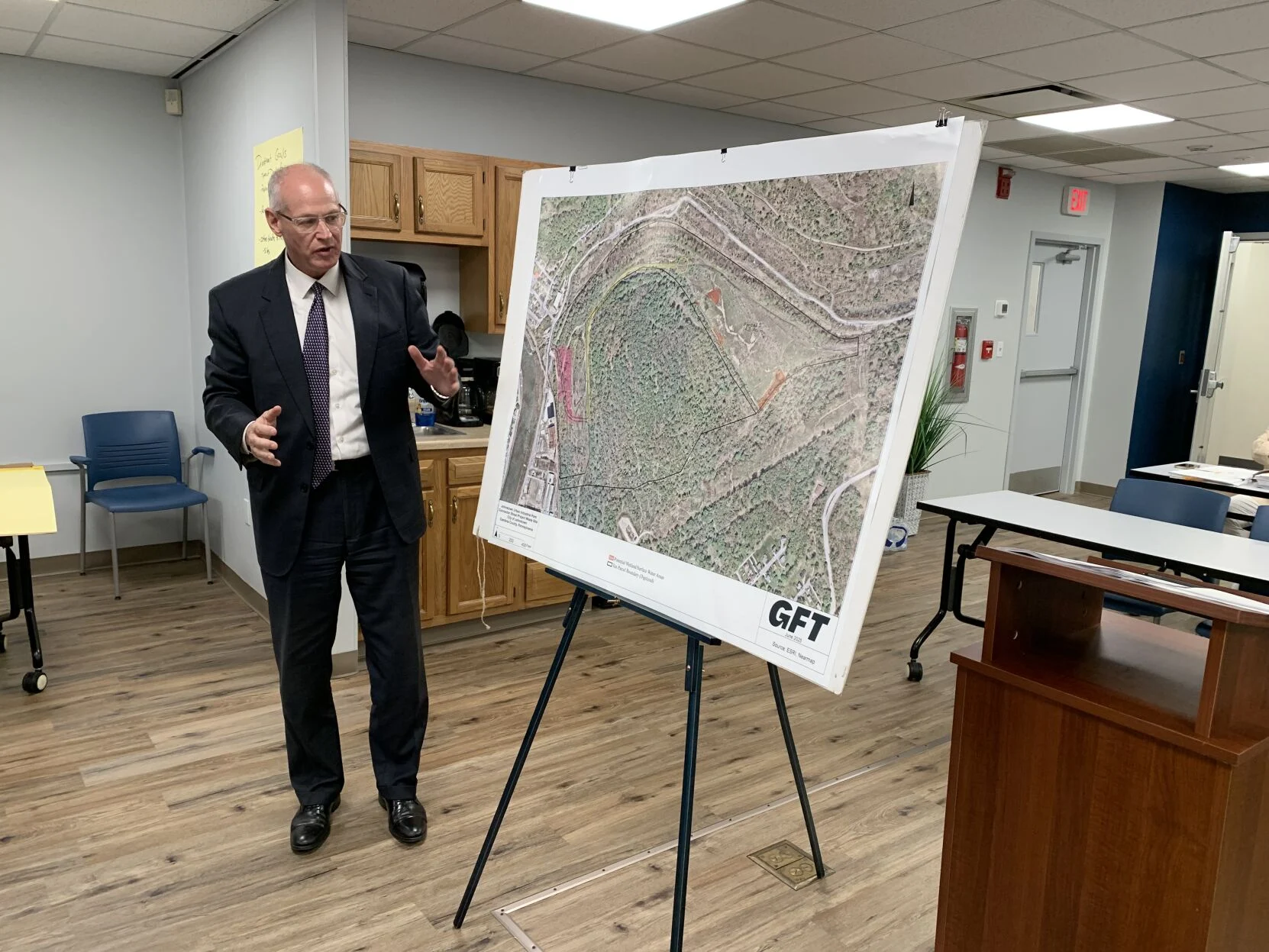
JOHNSTOWN, Pa. – Parcels of land at the Johnstown Urban Industrial Park could be ready for sale in 2027, with the building of structures possibly occurring in 2028.
Johnstown Redevelopment Authority Executive Director Mark Critz referred to that timeline as an “aggressive goal.” But he also felt that “if things fall into place, we could legitimately make that happen.”
Whenever businesses finally move onto the site, it will be the culmination of a long process that dates back to at least the early 2010s, when the tracts, located on the Minersville hillside above Iron Street, were designated as Keystone Opportunity Expansion Zones that can offer tax incentives.
The park could be home to a variety of businesses, including manufacturing, agriculture and white-collar operations.
“I just think it will increase employment,” JRA Chairman Mark Pasquerilla said. “The city doesn’t really have its own industrial park. I just think it will be good to have something in the City of Johnstown.”
An access road is being built.
Construction was temporarily halted when excavation unearthed concrete storage bins on the Cambria Iron and Steel National Historic Landmark property.
JRA, the Pennsylvania Department of Transportation, the National Park Service, Heritage Johnstown and the Pennsylvania State Historic Preservation Office developed a plan regarding the bins and any other possible historic artifacts discovered. Then construction resumed.
“My hope – and this is not set in stone – but my hope is that they will be paving the connector road sometime in spring, summer,” Critz said.
“We just signed the contract with PennDOT to start the design work on Phase Two. So that will go to contract here shortly, where the design of the second phase of the road, which will be the rest of the park, will be in design, and hopefully that will be done this summer.”

An engineering study will also be conducted for the utility infrastructure.
There are 115 acres of land that used to be Bethlehem Steel’s Rosedale/Lower Ore Yard and Matterhorn Tracts on the Minersville hillside.
For generations, the land was home to mills that made the steel that helped build the region and the nation.
“The legacy of Cambria Iron and then Bethlehem Steel is that everyone remembers the buildings, and all the activity that existed there, and then really the terribleness of when everything shut down and these enormous buildings being empty or being no activity whatsoever and … the prospect that they were going to be disaster sites, for lack of a better term,” Critz said.
“It’s a part of saying, ‘No, no, no, these are worthwhile sites that can have life again. It won’t be the same that it was, but we can still do things.’ ”
Approximately 25 acres will be used for the park itself.
Critz not only wants business development, but would also like to see the park connected to the city’s steelmaking heritage, outdoor recreation and tourism.
“Let’s tie all these things together because we have a great tourism heritage story that is throughout this city, and I think this park can be a part of it,” Critz said.
Critz added: “We feel an obligation that what we’re going to do up there also continues the story that, ‘Hey, this is what Johnstown used to be. This is the story we want to tell you. This is how we got to where we are. And we’re transitioning. We’re building on that legacy.’ ”
Reposted with permission.